

For the past couple of years, the technology sector has been obsessed with a single concept: prompt engineering. We have been told repeatedly that to harness the power of artificial intelligence, we must master the art of writing the perfect prompt. The prevailing wisdom suggested that a robust vocabulary and a meticulously crafted sentence were the keys to unlocking high-quality AI outputs.
However, as AI capabilities rapidly evolve, the rules of engagement are changing. If you have spent countless hours agonizing over the perfect wording for a single prompt, you might be frustrated to learn that writing a standalone prompt is no longer enough to guarantee success. The paradigm is shifting away from isolated inputs toward continuous systems. Welcome to the era of Loop Engineering.

The Limits of the “One-Shot” Prompt
To understand why the industry is moving toward Loop Engineering, we must first look at what prompt engineering does well—and where it falls short.
Prompt engineering is essentially the engineering of a single sentence. It relies on the assumption that if you provide the correct words, the precise numbers, the right sequence, and the perfect examples in one go, the AI will solve your problem.
In traditional engineering terms, this is known as an “open loop” system. You send a signal to a system, and it returns a result. The output drops directly in front of you as raw data, without passing through any internal filters, quality checks, or self-correction mechanisms.
If you have used generative AI, you already know the limitations of the open loop. You write a prompt and receive a response, but it is rarely exactly what you wanted. You follow up, asking the system to tweak a paragraph or adjust its tone. After several minutes of back-and-forth, you realize you haven’t made much progress. Out of frustration, you often end up taking the raw output and fixing it manually.
The fundamental problem isn’t that your initial prompt was poorly written. The problem is treating interactions with AI as single-shot transactions. The reality is that truly excellent results are born from continuous cycles, not isolated commands.
What is Loop Engineering?
Loop Engineering moves away from linguistic wordsmithing and focuses instead on system design. While prompt engineering gives an instruction, Loop Engineering builds a process.
A “closed loop” system is one where a process continuously checks itself. In a closed loop AI workflow, the AI generates an output and then immediately tests that output against a set of predefined criteria. If the AI detects an error or a missing element, it takes that information, attempts to correct the mistake, and tests the new output again. This cycle continues until all criteria are successfully met.
This shift is possible today because modern AI models have matured. Only a couple of years ago, AI models were incapable of properly evaluating their own outputs. They would simply generate text and stop. Today’s models are highly capable of catching their own mistakes, critiquing their own logic, and retaining memory of past errors so they do not repeat them in the next cycle. As a result, prompt engineering hasn’t died—it has essentially received a promotion into this larger, iterative framework.
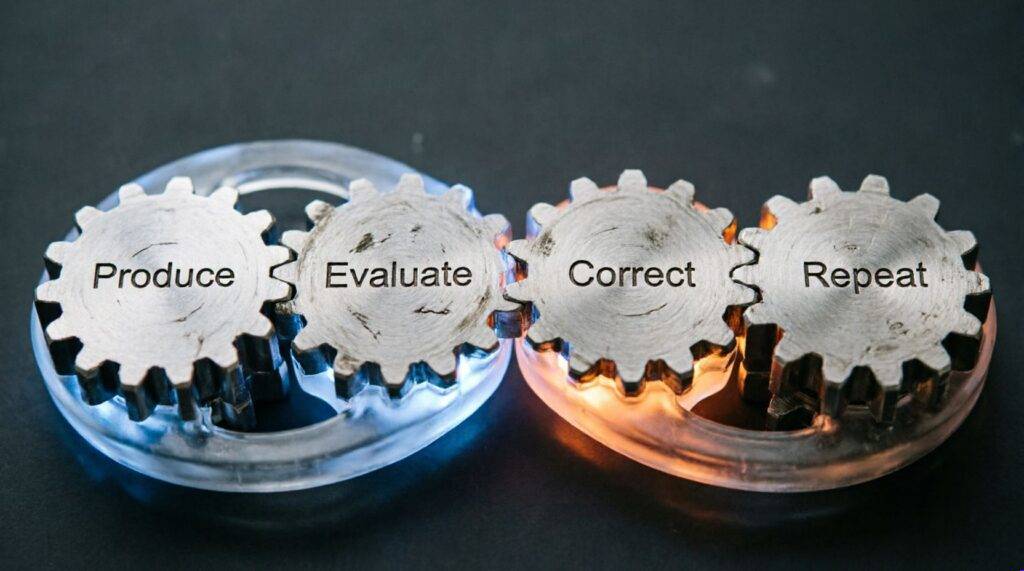
The Four-Step Feedback Loop
You do not need to be a traditional systems engineer to utilize Loop Engineering; you simply need to change your way of thinking. Loop Engineering can be broken down into a simple, four-step pattern:
- Produce: The AI generates an initial draft or hypothesis.
- Evaluate: The AI (or a human-in-the-loop) tests the output against specific, rigorous criteria.
- Correct: Errors, weaknesses, or hallucinations are identified and modified.
- Repeat: The cycle runs again until the output meets the established standards.
Establishing the evaluation criteria is often the most difficult part of this process. Without a solid foundation of domain knowledge, you cannot set effective criteria for the AI to follow.
We can see this in everyday professional tasks. For example, if you want an AI to write an email asking for a raise, a prompt engineer asks for a “professional, persuasive email”. A Loop Engineer, however, instructs the AI to write the email, read it from the perspective of a defensive manager, soften the tone if necessary, review it again from an HR perspective for corporate risk, and only output the final version that passes both tests. The AI acts as its own quality-control filter.

Loop Engineering in Cybersecurity
While the concept applies to emails and slide decks, Loop Engineering becomes genuinely powerful in high-stakes environments like cybersecurity. Security teams are overwhelmed by data, and single-shot AI prompts are rarely reliable enough for operational defense. By applying the Produce-Evaluate-Correct-Repeat framework, security practitioners can build highly resilient AI workflows.
1. Phishing-Email Triage
Security Operations Centers (SOCs) are constantly bombarded with user-reported phishing emails. A prompt engineering approach might ask an AI to “analyze this email for phishing indicators.” This open loop often results in high false-positive rates.
A Loop Engineering approach builds a system:
- Produce: The AI reviews the email and drafts an initial threat score.
- Evaluate: The system queries a secondary AI (or a specific rule-set) to check if the sender domain is actually a known, safe internal vendor.
- Correct: If the domain is safe, the AI adjusts its initial score and downgrades the threat level.
- Repeat: The AI presents the refined triage assessment to a human analyst for final approval, learning from any subsequent human corrections.
2. Incident Report Generation
Writing post-incident reports is tedious. A standard prompt might simply ask an AI to summarize a log file. A closed-loop system acts more like a rigorous editor. You can instruct the AI to draft the incident summary, and then automatically evaluate its own draft against a compliance checklist (e.g., “Did I include the time to mitigation? Did I map this to the MITRE ATT&CK framework?”). If it finds missing elements, it fetches the missing context and rewrites the report before presenting it to the incident commander.
3. Detection Rule Refinement
When writing new detection rules (like YARA or Sigma rules), a one-shot AI generation is risky and prone to syntax errors. Under Loop Engineering, the AI generates the rule, passes it to a safe, sandboxed test environment to run against historical benign traffic, and observes the results. If the rule triggers thousands of false positives, the test environment feeds that failure back into the AI. The AI evaluates why it failed, tightens the parameters of the rule, and tests it again.
Risks and Limitations
While Loop Engineering is a massive leap forward, it introduces unique challenges that technology leaders must navigate carefully.
- Garbage-In, Garbage-Out Criteria: The entire loop rests on the quality of your criteria. If your evaluation standards are vague, the AI will confidently iterate its way into generating useless information.
- Hallucination Loops: AI models can sometimes “hallucinate” or invent facts. In a closed loop, an AI might evaluate a hallucinated fact, confirm it using flawed internal logic, and double down on the error.
- Automation Bias and Overconfidence: When users see an AI iterating and critiquing its own work, they tend to trust the final output implicitly. This overconfidence is dangerous, particularly in cybersecurity.
- The Necessity of Human Oversight: AI should not operate entirely in a vacuum. Human beings remain an essential control point within these systems. Whether they are setting the initial criteria, reviewing the final output, or acting as an evaluation step in the middle of the loop, human analysts are non-negotiable.
Practical Advice for Adoption
If you want to transition your team from basic prompt writing to Loop Engineering, start small:
- Stop searching for the “magic prompt.” Abandon the idea that you can solve complex problems with a single input.
- Define your evaluation criteria. Before interacting with the AI, know exactly what success looks like and what rules the AI must follow to get there.
- Instruct the AI to critique itself. Build prompts that demand self-reflection. Ask the AI to build an argument, and then explicitly ask it to find the strongest arguments to destroy its own recommendation.
- Keep the human in the loop. Design your workflows so that critical decisions, especially in security, require human validation before execution.
The Loop is the Future
The evolution of artificial intelligence is moving away from static commands and toward dynamic workflows. Loop Engineering proves that the most valuable skill is no longer just stringing the right words together; it is the ability to architect a system that evaluates, learns, and corrects itself.
Prompt engineering is not dead, but it is no longer the final destination. By embracing the loop, you stop fighting with raw AI outputs and start managing intelligent, self-refining processes. The future belongs to those who build the best loops.

